-
Helsingin seudun & yliopiston Maan ystävien säännöllinen kokoontuminen (etäkokous)
Helsingin seudun & yliopiston Maan ystävät kokoontuu ti 7.4.2020 kello 18-20. Kokous pidetään koronatilanteen takia etäkokouksena Jitsi-videokokouspalvelussa.
Luvassa on toiminnansuunnittelua ja keskustelua ajankohtaisista asioista. Tarvittaessa puhutaan englantia tai tulkataan. Tervetuloa!
Ilmoittaudu viimeistään 7.4. klo 16 osoitteeseen: helsinki [at] maanystavat.fi Osallistumislinkki lähetetään ilmoittautuneille ennen kokousta.
—
Friends of the Earth Helsinki region & university will have a meeting on Tuesday, April 7th from 6 to 8 PM online at the Jitsi video conference service due to the corona situation.
There will be planning of upcoming activities and discussions. If need be, the meeting will be held in English or a translation provided. Welcome!
Sign up to the meeting by April 7th 4 PM to: helsinki [at] maanystavat.fi The Jitsi link will be sent to the participants before the meeting.
-
Pulp and Bioenergy Company’s Claim of Green Leadership Fails Fact Check
A discussion document released by the Environmental Paper Network (EPN) unveils the social and environmental risks associated with the Finnish company UPM-Kymmene and its operations in Uruguay, and highlights the importance of strong social and environmental risk management policies and close scrutiny of individual investments.
UPM is one of the world’s largest producers of pulp and bioenergy and recently announced that CDP, formerly Carbon Disclosure Project, had recognised “UPM’s exceptional leadership for its environmental performances, for its actions to mitigate climate risk”. However the scale of the UPM’s claims are not supported by current science.
EPN objects for instance to the company’s claims that its exotic tree plantations established in Uruguay constitute a carbon sink of approximately 24 million tonnes “that did not exist 30 years ago.”
Sergio Baffoni, EPN International forest campaign coordinator said: “The 24 million tonnes carbon sink exists only in theory, not in reality. The trees planted by UPM in Uruguay will not store carbon indefinitely, but will be intensively managed, logged and used to produce paper (1), while part of it is immediately burned to generate electricity.”
A recent scientific study from Uruguay measured the loss of 16.6 tonnes of soil organic carbon per hectare in soils under 20 year-old Eucalyptus sp. plantations. Across the country, UPM controls around 184,000 hectares of land planted with Eucalyptus sp. and Pinus Radiata. A simple calculation of the research’s conclusion (16.6 tonnes/ha) and multiplying it by UPMs land base, (154,800 ha of Eucalyptus sp. plantations) results in an estimated loss of more than three million (3,054,400) tonnes of soil organic carbon degraded by UPM in establishing its plantations. The inclusion of those plantations managed by UPM’s 600 independent suppliers in Uruguay would further increase the amount of attributable soil carbon loss.
Luisa Colasimone, EPN International coordinator, said: “UPM’s claims to climate change leadership, preventing deforestation and improving water security do not stand a realistic fact check. UPM’s projects in Uruguay, which include the further expansion of eucalyptus plantations, and the building of a new pulp mill in Paso de los Toros, can have serious impacts on water resources and climate protection, as well as other environmental and social impacts.” (2)
The replacement of historical natural grasslands with eucalyptus plantations has eroded biodiversity and carbon storage. For centuries, natural grassland, partially used as traditional extensive pasture, extended in the areas now occupied by UPM plantations. The subtropical Campos savannah in Uruguay not only hosts unique biodiversity, but also stores large amounts of carbon in their extensive root systems under the ground. This is also true for the grasslands used as traditional pasture. A large part of this stored carbon has been released from the soil where eucalyptus plantations substituted the natural grasslands.
EPN strongly encourages all financiers and investors to reduce their social and environmental risk in the pulp and paper industry by strengthening their institutional policies following the EPN’s Green Paper, Red Lines recommended standards, which list the minimum requirements for pulp and paper industry projects to avoid harm to people and the environment.
–end–
Notes to Editors
(1) Paper is a product with a very short lifespan. A large majority of sub-products are disposed of within a few hours of their first use. While some wood products do store a portion of their carbon in long-term carbon ‘pools,’ for paper products this is simply not the case.
(2) UPM-Kymmene Corporation: UPM signs a EUR 750 million revolving credit facility with a margin tied to long-term biodiversity(…).Contacts:
Sergio Baffoni, sergio [at] environmentalpaper.org, +49 162 3812528
Ville-Veikko Hirvelä, ville-veikko.hirvela [at] maanystavat.fi
-
Hallituksen kokous ja poikkeustilan vaikutukset kevään toimintaan
Maan ystävien hallitus kokousti maaliskuussa poikkeuksellisesti etäyhteyden kautta Suomeen levinneen koronapandemian ja sen aiheuttaman poikkeustilan vuoksi. Kriisitilanne vaikuttaa radikaalisti järjestöjen toimintaan, sillä ihmiset eivät voi kokoontua ja tavata toisiaan normaalisti. Kevääksi suunnitellut tapahtumat on jouduttu perumaan, niistä esimerkkeinä kansalaisliikkeitä yhteen kokoava Sosiaalifoorumi ja perinteinen Maailma kylässä -festivaali, joihin MY:n oli tarkoitus osallistua. Toivon mukaan epidemia on ohi syksyyn mennessä ja tapahtumien järjestäminen jälleen mahdollista. Silloin on suunnitelmissa mm. Friends of the Earth Internationalin yleiskokous Saksassa, johon osallistuu edustajia myös Maan ystävistä. Mielenkiintoinen tilaisuus on myös YK:n kansainvälinen konferenssi kemikaaliturvallisuudesta, joka on määrä järjestää lokakuussa.
Hallituksen kokouksessa pohdittiin myös Maan ystävien kevätvuosikokouksen järjestelyitä, sillä pandemian vuoksi vaihtoehtoina on joko siirtää kokous tai pitää se etäyhteyden kautta. Vuosikokous päätettiin järjestää suunnitellusti huhtikuussa etäkokouksena. Opintokeskus Sivis ja SOSTE Suomen sosiaali ja terveys ry järjestivät yhdistyksille avuksi webinaarin, jossa annettiin vinkkejä etäkokouksen järjestämiseen.
Maan ystävien toimistolla on muutto edessä loppukeväästä lähestyvän remontin vuoksi, joten uusia tiloja on etsitty ja siihen liittyviä asioita on käyty hallituksen kokouksissa läpi. Maan ystävien oma väentapaaminen jouduttiin perumaan ja sen sijaan järjestetään uuden toimiston tuparit, näillä näkymin elokuussa.
Toivotan omasta puolestani paljon tsemppiä MY jäsenille ja aktiiveille haastavassa nykytilanteessa. Pidetään huolta itsestämme ja toisistamme!Tanja Pulliainen
-

Friends of the Earth Study Circle
Friends of the Earth Helsinki are organizing a study circle that is about to have its first session on Wednesday, April 1st, at 18.00. The meeting will be online. The language of this study circle is English.
In the study circle, we will meet every two weeks to discuss chapters of a book (or similar) that we agreed upon beforehand. We have identified two media that we will go through in the next couple of meetings:
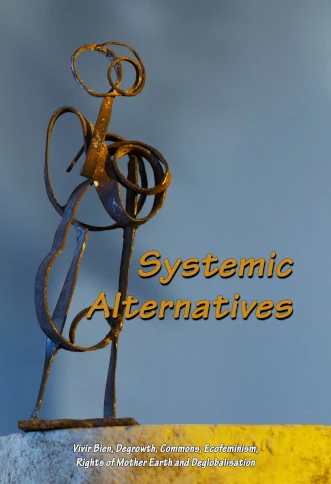
- The freely available book ”Systemic Alternatives” by various authors (description and link below)
- Environment-related episodes of the podcast ”The Ezra Klein Show”
In the next meeting, the discussion will be about the following two things:
- Chapters 1 and 2 of ”Systemic Alternatives” (Introduction and ”Vivir Bien” by Pablo Solón)
- The Ezra-Klein-Show episode called: ”We live in The Good Place. And we’re screwing it up.” (description and link below)
If you would like to participate without having read or listened to the material, you are still welcome to join.
To participate in the meeting, you can use a web browser or a smartphone app. There is no need to register anywhere.
If you use the web browser on your computer, you can participate without installing any additional software by visiting the following address around the time of the meeting:
https://meet.jit.si/FoE-Helsinki-Study-Circle_2020
Note that Chrome or Chromium are recommended at this point. The browser will ask you to allow the use of the microphone and webcam. If you don’t have a webcam or don’t want to use it, that’s fine. Please make sure in the sound settings of your computer that the microphone is not muted. Headphones or a headset are recommended for better audio quality.If you want to participate with a smartphone, download the ”Jitsi Meet” app (available for Android and iOS) and then enter the room name FoE-Helsinki-Study-Circle_2020 to join the call. (In the app settings, https://meet.jit.si must be set as the server, but this should be the default.)
Material
Systemic Alternatives
Website: https://systemicalternatives.org/2017/03/10/book-systemic-alternatives/
PDF freely available: https://systemicalternatives.files.wordpress.com/2017/03/sa-final-ingles-pdf2.pdfSummary
The premise of this publication is that we are living a systemic crisis that can only be solved through systemic alternatives. Humanity is facing a complex set of crises from environmental, economic, social to civilizational crisis. All of these crises are part of a whole. We cannot solve one of these crises without addressing the others.
The construction of complementarities between Vivir Bien, degrowth, commons, ecofeminism, Mother Earth rights, deglobalisation and other visions is essential to forge systemic alternatives to capitalism, productivism, extractivism, patriarchy and anthropocentrism. The main goal of this publication is to promote a constructive and creative dialogue between these different visions.
The Ezra Klein Show
Official website: https://www.vox.com/ezra-klein-show-podcast
Next session’s episode:
We live in The Good Place. And we’re screwing it up.
Available on various sources for podcasts; for example: https://www.stitcher.com/podcast/vox/the-ezra-klein-show/e/64883521Summary
Welcome to the first episode of our climate cluster. This isn’t a series about whether “the science is real” on climate change. This is a series about what the science says — and what it means for our lives, our politics, and our future.
I suspect I’m like a lot of people in that I accept that climate change is bad. What I struggle with is how bad. Is it an existential threat that eclipses all else? One of many serious problems politics must somehow address?
I wanted to kick off the series with someone who knows the science cold. Kate Marvel is a research scientist at NASA’s Goddard Institute for Space Studies and a professor at Columbia University’s Department of Applied Physics and Mathematics. But Marvel isn’t just a leading climate scientist. She’s also unique in her focus on the stories we tell each other, and ourselves, about climate change, and how they end up structuring our decisions. We discuss:- How a climate model actually works
- Why this is the good place
- Why there is so much variation in climate scientists’ predictions about global temperature increases
- Why global warming is only one piece of the much larger problem of climate change
- Why a hotter planet is more conducive to natural disasters
- The frightening differences between a world that experiences a 2°C temperature increase as opposed to a 5°C temperature increase
- Whether the threat of climate change requires solutions that break the boundaries of conventional politics
- The underlying stories that animate much of the climate debate
- Whether the planet can sustain continued economic growth
- What it means to “live morally” amid climate change
-

Helsingin seudun Maan ystävien kokoontuminen 10.3.
Helsingin seudun & yliopiston Maan ystävät kokoontuu ti 10.3.2020 kello 18-20. Paikkana on Helsingin yliopiston ylioppilaskunnan järjestötila Ulrika (ks. alla).
Luvassa on tulevan toiminnan suunnittelua, keskusteluja ja jotakin vegaanista naposteltavaa. Tarvittaessa puhutaan englantia tai tulkataan. Tervetuloa!
Järjestötila Ulrika sijaitsee Domus Gaudiumissa (Leppäsuonkatu 11) Etu-Töölössä. Sisäänkäynti on Leppäsuonkadun varrella pienellä aukiolla pyörätelineiden vieressä. Ovella on puhelinnumero, johon soitettuasi sinut tullaan päästämään sisälle. Ulrikaan päästäkseen ei tarvitse kulkea portaita (rakennuksessa on hissi), mutta sisätiloissa on joitakin kynnyksiä.
* * * * *
Friends of the Earth Helsinki region & university will have a meeting on Tuesday, March 10 from 6 to 8 P.M. in the student space Ulrika (see below).
There will be planning of future activities, discussions and some vegan snacks. If need be, the meeting will be held in English or a translation provided. Welcome!
Ulrika is a shared space for student associations located in the building Domus Gaudium (Leppäsuonkatu 11) in Etu-Töölö. The entrance to the building is on a small square on Leppäsuonkatu next to the bike racks. There will be a phone number at the door that you should call, so that someone can come and let you in. Ulrika can be accessed without using stairs (there’s an elevator in the building), but within the space there are some thresholds.
-
English-speaking study circle: first meeting Wed 18 Mar
The English-speaking group within Friends of the Earth Helsinki is starting a study circle on topics chosen by participants. The first gathering of this circle is on Wednesday the 18th of March at 6 P.M. online (due to the corona virus).
Our study circles usually work so that texts are selected together, participants read them in their own time and gatherings are devoted to discuss the texts in question (and any other subjects that spring to mind). In the first meeting we will decide what to read and at what pace, and all proposed texts will be introduced briefly. If you want to propose a text (book, article, report, play, blog post etc., also other types of media can be considered), be prepared to introduce it to others. You don’t necessarily have to have read the text. Also, we want to keep the study circle approachable, so that participants don’t need particular expertise beforehand, so very advanced theoretical or technical stuff is not that suitable for this.
Themes should somehow connect to what Friends of the Earth are dealing with, but this can be quite broad. So far texts have been proposed around the themes of climate change (IPCC reports), critiques of extractivism and new communication technologies, systemic alternatives and social ecology.
Due to the corona virus, the meeting has been moved from Ulrika to some suitable online platform. Please sign up for the study circle beforehand by e-mail (to the address below), so we can send you the link to the online meeting. We will use something like Jitsi Meet, so that you won’t need to install anything – just an up-to-date web browser should suffice. At least Chrome should work OK, there have been some problems with Firefox lately.
If you have any questions, you can contact us by e-mail: helsinki [at] maanystavat.fi
Welcome!

Muutos ei tapahdu itsestään,
se on tehtävä!